Wednesday, May 12, 2010

“It's as large as life, and twice as natural!”


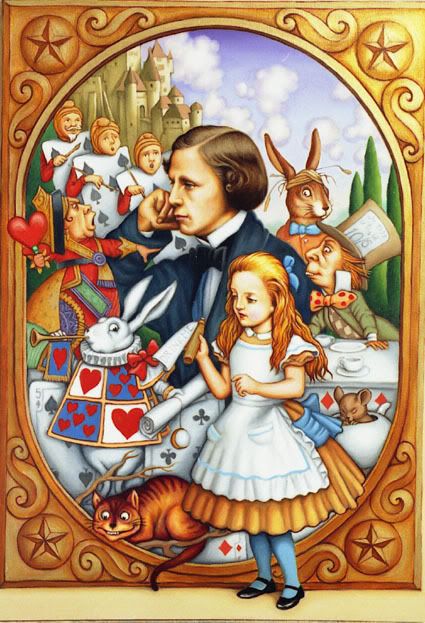
Lewis Carroll is best known for his stories of Alice. He sends a boring seven year old girl into a weird and unexplainable world to learn to grow up and face her real life problems. She follows the "white rabbit" down his rabbit hole as he talks about being late for a very important date. Once there she discovers that nothing makes much sense. She is confronted with a hookah smoking caterpillar who seems to have all the answers. Lewis Carroll's story has been re-told and adapted for years. Just recently Tim Burton created a 3-D version of Alice in Wonderland.
Lewis Carroll's vision will live on as long as someone still finds interest in him.


sources:
http://stellalee92.wordpress.com/2010/03/10/alice-in-wonderland-by-tim-burton-3d-movie-review/

Monday, May 3, 2010

'What is the use of a book', thought Alice, 'without pictures or conversations?'


Lewis Carrolls major works include:

Alice's Adventures in Wonderland (1865)
Bruno's Revenge (1867)
Phantasmagoria: And Other Poems (1869)
Through the Looking Glass and What Alice Found There (1871)
The Hunting of the Snark (1876)
The Wasp in a Wig (1877)
A Tangled Tale (1885)
The Nursery Alice (1889)
Sylvie and Bruno (1889)
Sylvie and Bruno Concluded (1893)
Three Sunsets: and Other Poems (1898)
For the Train: Five Poems and a Tale (1932)
The Rectory Umbrella and Mischmasch (1932)
Alice's Adventures Under Ground (1965)

In Alice in Wonderland a seven year old girl named Alice follows a Rabbit down a hole. She is thrown into a backwards world where nothing makes sense. She must learn how to get through and get home without being caught by the Queen of Hearts. Along her journey she meets an interesting array of characters including the Mad Hatter, Cheshire Cat, a Caterpillar, and the White Queen.

Sylvie and Bruno is more of a collection of thoughts and ideas thrown together into a story of sorts. The narrator of the book is never named, but you get the sense that it is just Lewis Carroll himself. It's written in a sort of opiate dream state where neither the reader nor he knows whether he's asleep or awake. It concerns these two young sprites, Sylvie and Bruno, from fairyland and a mysterious, beautiful woman named Muriel he's not sure exists. It's very Victorian, dark and whimsical at the same time. There is a pretty great Carolinian passage where he basically predicts the theory of relativity by suggesting a falling tea party. The story continues in Sylvie and Bruno's Concluded.


Sources:
http://www.fantasticfiction.co.uk/c/lewis-carroll/
http://www.tower.com/sylvie-bruno-lewis-carroll-paperback/wapi/115013515


“When I use a word," Humpty Dumpty said in rather a scornful tone, "it means just what I choose it to mean - neither more nor less.”


Lewis Carroll has a unique style that he created. His backgrounds in mathematics and logic have a lot to do with the style he chose. Other influences for his writing could have been his interest in photography, abnormal eating habits, dual personality, sleeping difficulties, Victorian lifestyle, and neglected childhood. Most of his stories center on ideas similar to these. Although well known for his Alice stories, Carroll didn't only write in prose, he wrote many poems and shorter pieces. Carroll had a negative association with eating. He would normally skip lunch and ate very little for dinner. In most of his stories food is associated somehow. In Alice in Wonderland, eating and drinking makes her change size rather drastically. Eating is associated with sin as far back as Adam and Eve. Alice is tempted to eat the Queens tarts while in Wonderland, which she knows to be wrong. Even the Chesire Cat is associated with eating as a sin. The last part of him to disappear and the first to reappear is his mouth. Split personality is present in his stories. Lewis Carroll himself has a split personality of sorts. In Alice in Wonderland, Tweedledee and Tweedledum are twins who are constantly contradicting each other's opinions. Also as Alice falls down the rabbit hole, the top becomes the bottom and the bottom becomes the top.
Lewis Carroll uses a lot of rhyming, alliteration, personification, and imagery in his stories. He creates these magical worlds that he then has to explain in a way children can understand. By using these techniques, he keeps the audience's attention and they are able to immerse themselves in the words. He also uses a lot of parentheses, Italics, and capital letters. This makes the text a little more exciting and doesn't tire ones eyes as fast. It gives it a somewhat unprofessional look to it, but he was writing for children, not scholars.

sources:
http://aliceproject5.wordpress.com/2009/10/29/the-peculiar-writing-style-of-lewis-carroll/
http://www.essayforum.com/essay-writing-feedback-3/lewis-carroll-biography-style-literary-devices-2342/
http://www.pazooter.com/carroll/lcbio.html